




Hair loss is a common concern among men and women in their 20s, 30s, and beyond. Probably due to their poor haircare routine, chronic stress, hormonal imbalances, nutrient deficiencies, autoimmune diseases, tight hairstyles, heat and chemicals exposure, pollution and UV exposure, bad lifestyle habits, or use of certain medications/topicals.
Thankfully, there are modern dermatological treatments for hair loss that address hair loss safely and effectively, with minimal downtime. Amongst all, advanced P-RP (plat-elet Rich pla-sma) therapy or hair transplant in Jayanagar are mostly sought by both men and women.
Thinking, which one is right for you?
Well, your hair loss type and severity, long-term goals, and treatment expectations are the deciding factors in your hair loss treatment.
If still confused, this guide by a hair loss doctor in Jayanagar, Bangalore at Aarna Clinic provides details to compare both treatments, Hair Transplant and P-RP, and can help you make a well-thought-out, informed choice.
What is Hair Transplant Treatment?
Hair transplantation is an irreversible, natural hair restoration approach in which viable hair follicles are collected from the back or sides of the scalp (donor sites) and implanted into hair-thinning or balding areas (recipient sites).
It’s a surgical procedure in which the patient’s healthy hair roots are harvested using the traditional FUT method or the advanced FUE technique and carefully placed in the recipient areas. The transplanted recipient areas actually start growing hair permanently, as the hair follicles implanted there are genetically resistant to permanent shedding.
What is P-RP Therapy for Hair Loss?
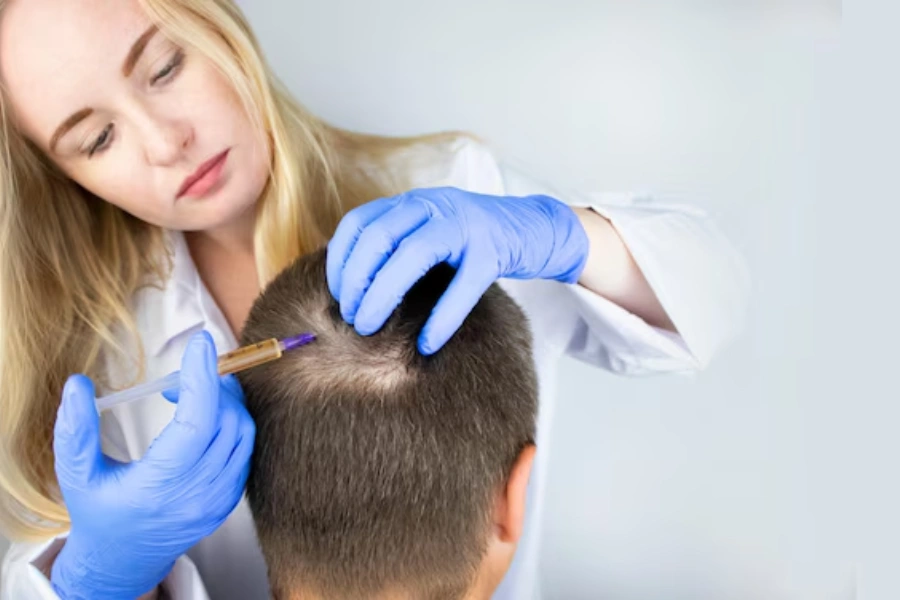
P-RP therapy is a minimally invasive, injectable approach that stimulates healthy, thicker, and stronger hair growth from existing undamaged hair follicles.
The procedure involves collecting small portions of the patient’s blood in a centrifuge tube and processing it to separate plat-elet-rich pla-sma from other blood components. This P-RP solution is extracted and injected into the scalp’s hair-thinning or hair-loss-affected areas to reactivate weak or dormant hair follicles and stimulate hair growth.
As P-RP contains essential growth factors and proteins, it supports hair cell repair and regeneration.
Also improves scalp microcirculation and nourishes existing hair roots. Thus, after P-RP sessions, hair fall gets reduced, and hair grows thicker, stronger, and in greater numbers.
Confused Between Hair Transplant and P-RP? Here’s What You Need to Know
This table highlights the key differences between hair transplant and P-RP therapy to help you make an informed choice.
| Features | Hair Transplant | P-RP Hair Therapy |
| Type of Approach | A surgical treatment for hair loss. | A non-surgical, injectable treatment for hair loss. |
| Results | Provide permanent, natural hair restoration. Patients can care for their new hair just like normal hair. | Provide temporary healthy, thicker, and stronger hair- overall good quality hair growth. Maintenance sessions are required. |
| Recommended For | Those who are suffering from an advanced stage of hair loss or baldness. | Those who are suffering from mild to moderate hair thinning or hair loss, poor scalp health, and weak, frizzy, brittle, or poor-quality hair growth. |
| Sessions Needed | Just a single, 4-8-hour-long session or shorter surgery completed in two consecutive days. | Multiple sessions, around 3 to 6 and beyond, are required for optimal results. |
| Pain/Discomfort Level | Surgery is performed under local anaesthesia, so pain is not felt. Post-surgery discomfort is mild, temporary, and manageable with a painkiller. | A tolerable, slight, quick pricking or stinging sensation is common. But with the use of numbing agents and cooling packs, there is no pain. |
| Downtime | Patients can resume their normal routine only after 5-10 days. | Patients can resume daily activities the same or the next day of the session. |
What Results Can You Expect?
Following a hair transplant:
- Transplanted hair sheds due to the surgical shock of the hair roots, anywhere between 2 and 12 weeks.
- New hair growth starts in 3-4 months.
- Desired, permanent hair coverage and thickness are visible in 8-12 months.
- Following a P-RP hair therapy for hair loss:
- Hair fall is significantly reduced after 3-4 sessions.
- Hair grows thicker within 2-3 months.
- Final results need touch-ups every 4-6 months.
Hair Transplant Vs P-RP Hair Therapy Cost
The average cost of a hair transplant in Jayanagar ranges from INR 30,000 to INR 1,50,000+.
P-RP hair therapy costs start from INR 3,000-8,000 per session in Jayanagar.
The final cost of your hair loss treatment is affected by the following factors:
- Extent of hair thinning/hair loss
- Chosen treatment and technique
- Number of hair grafts required (for hair transplant)
- Number of sessions required (for P-RP hair therapy)
- Location, infrastructure, and reputation of the clinic
- Provider’s expertise and experience.
A detailed consultation with a hair loss doctor can only help determine the best-suited treatment and its price.
So, Which Is Better: P-RP or Hair Transplant?
P-RP hair therapy is worth considering if:
- Having early to moderate hair thinning
- Weak or dormant hair follicles are present
- Seeking a non-surgical hair loss treatment
- Need better quality/thickness/strength of hair growth
- Hair fall is sudden.
Hair transplant must be chosen if:
- Struggling with noticeable hair thinning and bald patches
- Hair follicles are absent or barely present
- Seeking a permanent, natural hair restoration
- Failed to get the desired hair thickness or coverage with P-RP or other topicals.
Can P-RP and Hair Transplant Be Done Together?
Yes. A combination approach always yields optimal treatment outcomes.
Using P-RP before a hair transplant can improve scalp condition, creating an environment that supports quick healing and stronger, lasting, dense hair growth.
And, using P-RP after hair transplant can improve the survival of transplanted grafts and facilitate long-term, stronger hair growth.
The Conclusion: How to Choose the Right Hair Loss Treatment for You?
Consult a dermatologist at Aarna Clinic to get a personalized hair loss treatment plan. A good dermatologist will determine the best-suited treatment after assessing your hair loss stage, scalp health, existing hair follicles, medical records, age, and treatment goals/expectations.
If your hair is thinning or hair loss is at an early stage, you have the option to delay or reverse it with P-RP hair therapy. But if you are late and the concern has advanced, a hair transplant can only help you restore your natural hair growth.
With the right strategic approach, probably a combination approach, hair loss doctors in Jayanagar, Bangalore at Aarna Clinic can help you get back your normal head full of natural, healthy hair and reclaim your confidence!
FAQs on Hair Transplant Vs P-RP Therapy
Is P-RP better than a hair transplant?
Let your dermatologist decide this for you. P-RP works only for early-stage hair loss, and a transplant is for advanced baldness.
How long do P-RP results last?
P-RP effects on the scalp and hair last for only 6-12 months. You will need repeated P-RP applications for sustained results.
Can P-RP regrow hair on a completely bald scalp?
No. P-RP targets weak or dormant hair follicles.
Is a hair transplant 100% successful?
With an experienced, expert hair restoration surgeon, the success rate of hair transplant is above 95% to 98%.
Which looks more natural- P-RP or transplant?
Both. A hair transplant involves relocating the patient’s own hair follicles to grow new, natural hair in bald areas, while P-RP improves the health and quality of the patient’s existing natural hair.